|
|
|
An insight into the history of each of the S-set double-deck cars obtained by the Society for preservation. Historical notes provided by Michael McGinty
This section contains is a pictorial and historical record of each of
these suburban cars acquired by the Society for long-term preservation.
|
|
|
Background
Between 1970 and 1987 there were 6 series of double-deck stainless-steel suburban cars built for the NSWGR, Public Transport Commission of NSW and the State Rail Authority of NSW. Series 2 to Series 6 were delivered with an unpainted gleaming stainless-steel finish. Series 1 to Series 4 carriages were non-airconditioned stock and Series 5 and Series 6 carriages were airconditioned.
- Production Series 1 comprised 53 painted stainless steel motor cars made by Comeng (used with 53 converted Tulloch double-deck aluminium and steel trailer cars (T4841, T4842 and T4845 to T4895) altered to run with these carriages).
- Series 2 comprised 106 unpainted polished stainless-steel cars made by Comeng
 |
|
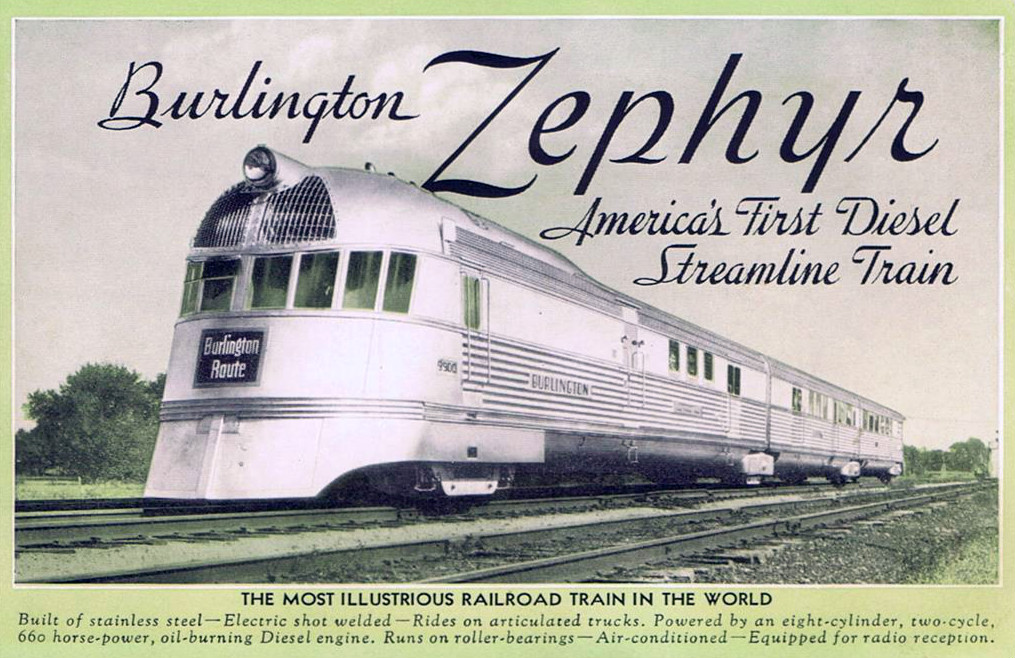
Postcard showing the Budd-built Burlington Zephyr trainset, introduced by the Chicago, Burlington & Quincy Railroad (CB&Q) in 1934. This was the first-ever stainless-steel train, which was built using the patented Budd stainless-steel fabrication system, later used by Commonwealth Engineering for NSW rolling stock. This original Zephyr train is preserved.
|
|
|
- Series 3 comprised 150 unpainted polished stainless-steel cars made by Comeng
- Series 4 comprised 200 unpainted polished/bright stainless-steel cars made by Comeng and Goninan
- Series 5 (K-sets) comprised 160 unpainted bright stainless-steel cars made by Goninan
- Series 6 (C-sets) comprised 56 unpainted bright stainless-steel cars made by Goninan
Of the total of 509 series 1 to series 4 stainless-steel double-deck suburban carriages originally made, only 16 still exist today, as preserved or retained cars. SETS has 4 of these.
Commonwealth Engineering licensed the Budd-patent stainless-steel carriage construction system that had been first used to make railway carriages in America (where the Budd Company was based) in 1934.
The first breakthrough by the Edward G. Budd Manufacturing Co. had been working out how to electrically shotweld (a line of spot weld) thin sheets of stainless-steel together, with just sufficient heat to fuse them, without overheating, by controlling the electric welding current and timing.
But the second element of the Budd design was inserting tight fitting polished stainless-steel fluting strips into the pressed carriage ridged side base sheets, which boosted strength and stiffened the carriage sides and gave the cars their striking gleaming horizontal lined appearence.
While Commonwealth Engineering used the Budd system, A. Goninan and Co. used the Pullman Standard stainless-steel fabrication system. This was a derivation of the Budd system concepts but without the inserted fluting strips.
|
|
C 3861 - 1972 Commonwealth Engineering Series 2 Stainless Steel "Comeng" Motor Car
|

C 3861 at Leppington Yard on S 146 on 3rd March 2015.
Photograph: Michael McGinty
|
|
C 3861 was the fourth Power Car to be built and delivered by Commonwealth Engineering in the second order of Double Deck cars for the Public Transport Commission of NSW, after the first series of 53 similar "production" motor cars was considered a success.
This full order consisted of Power Cars C 3858 – C 3911, Driving Trailers D 4011 – D 4020, which were built without crew compartment side doors, and Trailer Cars T 4921 – T 4962, which were built without a crew compartment. This contract contained the first order of stainless-steel Trailer cars to be built for suburban services. All these cars were designed and built in Australia under license and with technical assistance from the Budd Company in the USA.
Unlike the first order of 53 Power Cars from Commonwealth Engineering (C 3805 – C 3857) which were paint finished, the cars in the second order were given a complete external makeover to be unpainted and have a shiny stainless-steel finish instead, with blue car numbers and NSW Transport logos applied.
C 3861 was delivered from Commonwealth Engineering on 4th December 1973 and was placed into service on 20th February 1974 on to set S 13.
Compared to the Series 1 cars, the power car design in this second batch of cars was modified, with the previously tapered shape of the number 1 end (pantograph end), now made completely flat. Also the car end windows were reshaped, the interior colour scheme on the window surrounds was altered, and the passenger seats were redesigned to rollover as opposed to the walk over style used on first series cars.
These cars featured Commonwealth Engineering builders plates as opposed to Comeng builders plates fitted to later carriages and the light covers were also of a different design to those on first series cars.
C 3861 underwent a major refurbishment at A Goninan & Co at Broadmeadow (Newcastle) as a part of the CityDecker project, commencing on 1st December 1997 and the car was outshopped seven weeks later on 28th January 1998. This refurbishment programe was done as part of the lead-up to the Sydney 2000 Olympic Games. The works included changing the stainless-steel suburban car interior liveries to an off-white scheme and fitting glass vestibule to end saloon bulkheads, making all the cars internally resemble the later C-sets.
Like all Comeng suburban power cars up to and including C 3936, this car was built with a ratchet handbrake but was modified to have spring park brakes fitted in the early 2000’s.
This carriage was last given a major overhaul in late 2014/early 2015. After 45 years and 4 months service C 3861 was retired on 18th June 2019 on set S 56. The car was nominated for preservation by staff at Flemington Maintenance Centre.
|
|
T 4983 - 1975 Commonwealth Engineering Series 3 Stainless Steel "Comeng" Trailer Car
|

T 4983 on set S 140 at Casula on 22nd March 2019.
Photograph: Michael McGinty
|
|
T 4983 was manufactured by Commonwealth Engineering at their plant in Granville, NSW as a part of the third series of carriages ordered by Public Transport Commission of NSW. This order consisted of 75 power cars, C 3912 to C 3986, 50 Driving Trailers, D 4021 – D 4070, and 25 Trailer cars, T 4963 – T 4987. These cars were designed and built in Australia under license and with technical assistance from the Budd Company in the USA.
T 4983 was delivered on 20th November 1978 and placed into service on set S 56 on 12th January 1979. This carriage is an example of the standard trailer carriages that were built without crew compartments to operate in the S, L and R set fleet. Further it is the only example of a group of 25 cars that were built with improved ventilation of the passenger saloons. This improvement was achieved by installation into the carriage sides of an additional motorised vent in the centre of the carriage which was not included in the earlier order of cars T 4921 – T 4962. This order of the carriages also feature a revision of the builders plates with the branding of Commonwealth Engineering to Comeng.
T 4983 underwent a major refurbishment at A Goninan & Co. as part of the CityDecker project, done as part of getting the whole train fleet ready for the Sydney 2000 Olympic Games. These works commenced on 11th September 1996 and the car was outshopped five weeks later on 24th October 1996.
This carriage had a fairly uneventful operating life and was retired on the final day of revenue service for S sets on Friday 28th June 2019 in company with preserved power car C 3057 on set S 140, on run number 7.
|
|
Former D 4080 (now T4003) - 1978 Commonwealth Engineering Series 4 Stainless Steel "Comeng" Control Trailer Car
|

T 4003 on set S135 at Olympic Park on 5th March 2015.
Photograph: Stephen Halgren
|
|
T 4003 is the most complete example of a preserved S-set car that was built as a Driving Trailer by Commonwealth Engineering. This car was originally delivered as Driving Trailer car D 4080 on 5th March 1979 and entered service on 7th March 1979 as part of two car set T 24. D 4080 was a built as part of the final order for suburban carriages built by Comeng and this order was made up of 25 Power Cars, C 3741 – C 3765, and 25 Driving Trailers, D 4071 – D 4095. Again these cars were designed and built in Australia under license and with technical assistance from the Budd Company in the USA.
The carriages in this order, just like previous orders of carriages delivered from Comeng, featured some minor design improvements that were never retrofitted to older cars. In this order, the position of the filler for the window washer bottles for the driver’’s front windscreen was altered and the interior wall panels behind the crew compartment were altered so that the window surround was flush with the wall panels and a small fiberglass surround was made to wrap around the small window in this place. They all entered service with blue external car numbers and two tone blue L7 logos. They were also the first cars delivered from Comeng with blue Guards’ lights above the crew compartment doors.
In 1987, usage of all of the Double Deck Driving Trailers as terminal cars was discontinued, however ten cars were retained as full operational terminal cars to operated local services between Newcastle and Fassifern as two car L sets, and they were later used on services in the first year of operation of electric trains between Richmond and Riverstone, which opened on 17th August 1991. These ten carriages were selected from this order of cars and were especially renumbered D 4001 – D 4010, numbers that were unused since the withdrawal of the ten wooden Bradfield Driving Trailers in the early 1970’s. In the middle of 1992, the power supply between Riverstone and Richmond was boosted and eight car trains were able to provide services on the full length of the line.
In 1996, a decision was made to reactivate two car electric trains to operate local all stations services on the Central Coast and South Coast lines, in line with a new timetable which commenced on 3rd November 1996. As a part of their Olympic Games lead-up refurbishments, these ten cars retained their crew compartment features and controls but were otherwise given a full CityDecker refurbishment. Five of these Driving Trailers were put to use on these two car L sets, however D 4003 was not used at anytime but remained nearly complete with only a few items of equipment needed to place this car into service as an operational terminal car.
T 4003 underwent a major refurbishment at A Goninan & Co as part of the CityDecker project commencing on 27th March 1996 and was outshopped six weeks later on 13th May 1996. It retained the D prefix for a number of years but as the driving cab was not fitted with a train radio, it was recoded to have the prefix “T” in the late 2000’s.
T 4003 remained in service until the very end of revenue services for S-sets and was a part of the very last S-set to carry passengers in revenue service in the early hours of Saturday 29th June 2019, on the Lidcombe – Olympic Park shuttle services, on run number L2, on set S 135. After 47 years of continuous operation of Double Deck Suburban S-sets, the final S-set rolled out of Lidcombe’s Sprint Platform at 12:27am, empty cars to Flemington MC, consisting of C 3871, T 4003, T 4046 and C 3972.
|
|
C 3057 - 1977 Goninan Series 4 Stainless Steel Motor Car
|

C 3057 on set S 140 at Casula on 22nd March 2019.
Photograph: Michael McGinty
|
|
C 3057 was manufactured by and delivered from A Goninan & Co’s Broadmeadow (Newcastle) plant on 22nd April 1980 and placed into service on set S 5 on 26th April 1980. This car is an example of the changes made for the design of the first model of suburban double-deck passenger carriage built by A Goninan & Co., which were numbered from C 3001 to C 3080. The Goninan cars were designed and built in Australia with technical assistance and licensing from Pullman Standard in the USA.
Unlike C 3001, preserved by Sydney Trains, C 3057 features straight guttering above the crew compartment side windows and side doors, as well as built-in circular shaped vents for the motorised fans on car sides which provide fresh air into the passenger saloons. Also the bottom deck floor and gondola is spot welded as opposed to being rivetted to the frame, as was the case on earlier cars. This car had blue external car numbers and two tone blue L7 logos applied. The Goninan Double Deck cars were the first electric cars to have blue Guard lights above the Crew Compartment doors.
C 3057 was used not only operated on suburban services as designed but also has history of working on local suburban services in the Newcastle – Fassifern services in the 1980’s on NC sets and later L sets after electrification reached Newcastle in 1984.
On 9th July 1997, C 3057 was leading set S 91 and sustained severe structural damage in a major derailment north of Hornsby Station. A newly qualified driver mistook the service for being on the main line but had actually been placed in the down refuge after departing Platform 2 at Hornsby on a Berowra service during the evening peak.
The service was planned to be held in the refuge to allow a Newcastle bound Interurban service to overtake, however the driver accelerated towards track speed for the main line, passing two signals at stop and running off the end of the track onto the gravel adjacent to the Down Main. The train ground to a halt, with a stanchion that had been knocked down by the second carriage, D 4051, collapsing across the pantograph and pantograph well at the number 1 end of C 3057.
Normally the level of structural damage sustained in this accident would have led to some cars simply being written off. However due to needing the maximum number of cars available for the 2000 Olympics, all the carriages were sent for repair. Thus C 3057 and the other damaged cars were rebuilt and returned to service in time for the Sydney 2000 Olympic Games.
While being repaired at A. Goninan & Co this carriage also underwent a major CityDecker refurbishment as part of the CityDecker project, with all works being completed over a four-week period commencing on 17th July 1997, and the car was outshopped on 14th August 1997.
C 3057 remained in service right up until the final day of revenue service for the S set fleet, Friday 28th June 2019, operating along with preserved trailer car T 4983 on set S 140, on run number 7, in company with set S 61.
|
|
Other preserved S-set Suburban Double-Deck Cars
|
 |
|
The Hon. Neville Wran Q.C. M.P., Premier of NSW, stands on the front of carriage C 3001 (note the S 55 target plate) to perform the official opening ceremony for the Eastern Suburbs Railway (ESR) on 23rd June 1979. This car was at the Sutherland end of the official train.
|
|
|
The Sydney Trains/Transport Heritage preserved S-set cars are as follows :-
- C 3805 (first production double-deck motor car) and T 4150 (1980 royal visit carriage) both for museum display.
- S28 - C 3986 (last Series 3 motor car), T 4050 (Series 3), T 4013 (Series 2) & C 3765 (last Series 4 Comeng motor car) as the official operational preserved set for Sydney Trains/Transport Heritage.
- S56 - C 3001 (ESR opening lead motor car), T 4101 (ESR opening attached trailer car), T 4961 (Series 2) & C 3862 (Series 2) are officially retained as an additional 4 car set held by Sydney Trains.
The histories of 9 of these other 10 carriages were outlined within the SETS S-set Farewell tour notes.
|
|
Further Information
|
See Also:
C-set Double Deck Suburban (EMU) Passenger Cars
U-set Single Deck Interurban (EMU) Passenger Cars
Electric Locomotive 4615
Electric Locomotive 8501
Electric Locomotive 8606
|
|
|


