|
|
 |
|
8606 sits powered up in Lithgow down yard awaiting a shunt to the Maintenance Centre, after a transfer from Clyde on 19th December 2018. A diesel shunt into the centre is currently required as the overhead wiring is presently switched off.
Photograph by Hugh Burns.
|
|
|
Summary
Built by Commonwealth Engineering of Granville N.S.W., with Mitsubishi Electrical Equipment, for the State Rail Authority of New South Wales, locomotive 8606 was delivered on 12th September 1983, and entered service on 21st September 1983. It had a short operational life of nearly 19 years service before retirement on 30th June 2002. It was sold for preservation on 21st February 2003, and is in operational condition.
Electric locomotives 8606 and 8649 are currently listed in the Transport for NSW Heavy Rail
Train Operating Conditions Manual under Sydney Electric Train Society.
The TOC Waiver currently applicable for Robel Train operations on the City Circle is Operation Of Locomotive Hauled Freight Services on the Airport and City Lines.
A typical TOC Waiver for electric locomotive hauled passenger trains on the City Circle is Approval To Operate Locomotive 8606 in the City Underground
The TOC Waiver currently applicable on ARTC controlled lines is Operation of Locomotive 85 and 86 Class on the ARTC Network.
Background
With the extension of electrification from Gosford to Newcastle (opened June 1984) and to Port Kembla (from December 1985), additional electric locomotives were required to service these new routes and add to the existing fleet of aging 46 class and newer 85 class electrics. The Commonwealth Engineering Company of Granville was again successful in winning the $118 million tender for 50 locomotives using Mitsubishi electrical equipment from Japan. They had previously built the 85 class, which were first introduced in May 1979. The 86 class electric locomotives were a further development from these, with an electrical design similar but not identical to that of the previous class. Compared to the 46 class, the 86 class had roomier cabs, modern amenities and were better riding for the crew, but their traction control system was less direct and slower to respond to the driver's commands.
The class leader 8601 was delivered in February 1983 and the penultimate member of the class, 8649, was delivered during late August 1985. However, the last of the class, 8650, was not delivered until January 1986 and underwent its trial trip on 6 January that year. 8650 was an experimental departure from the NSW norm in featuring the Bo-Bo-Bo ("tri-Bo") wheel arrangement. It was built as a prototype for the electric locomotive design Commonwealth Engineering planned to construct for Queensland Railways, having also successfully tendered for these locos.
 |
|
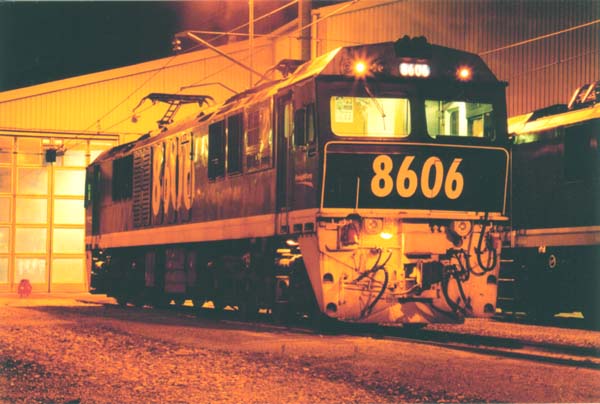
8606 sits powered up at Lithgow Locomotive Maintenance Centre around 4:00 am on 31st March 2003.
Photograph by Matthew Doyle.
|
|
|
Brief details of the N.S.W. "86 class" electric locomotives are as
follows:-
- Voltage: 1500 D.C.
- Gauge: 1435 mm
- Wheel arrangement: Co-Co (8601 - 8649); Bo-Bo-Bo (8650 only)
- Weight: 120 tonnes
- Axle load: 20 tonnes
- Length over couplers: 20.08 m
- Overall width: 2.886 m
- Height to lowered collector: 4.33 m
- One hour rating: 2880 kW
- Continuous rating: 2700 kW
- Continuous Tractive Effort: 222 kN (22200 daN)
- Maximum speed: 130 km/h
- Wheel Diameter: 1250 mm
- Gear Ratio: 79:20
- Control voltage: 120V D.C.
- Multiple Unit Operation: Up to 4 units
The Mitsubishi electrical equipment includes; six MB-485-BVR traction motors and MG-146-SF motor alternator. There are two Westinghouse 3VC75B compressors and two SMC-EK (Airmate) model WBX 22 pantographs. Traction control is by means of three camshaft controllers and electro-pneumatic contactors. The Mitsubishi control equipment allows manual and automatic (to current limit) notching, and regenerative braking, being operated under electronic control set by the driver's master controller (or jumpered train wires when operating in multiple unit).
 |
|
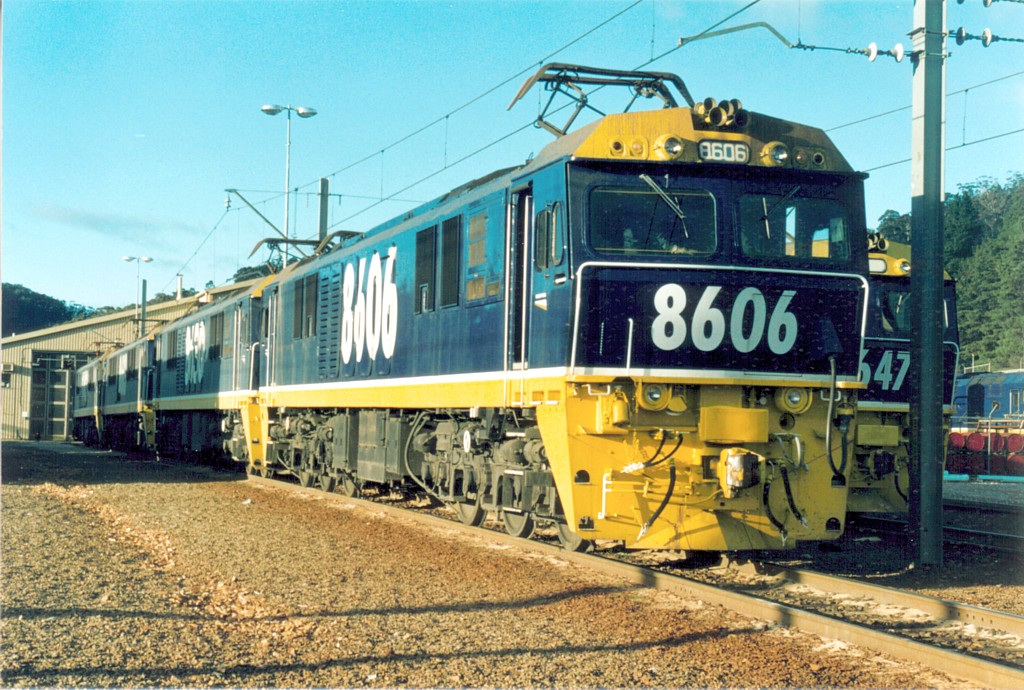
8606 in Lithgow Locomotive Maintenance Centre Yard in
1997. Photograph by Michael McGinty.
|
|
|
As the new class entered service they took over the handling of the most important express, mail and passenger trains, ranging from the Indian Pacific to and from Lithgow; the Brisbane Limited, Pacific Coast Motorail and Newcastle Expresses to and from Broadmeadow/Newcastle as well as inter-urban loco hauled services to Gosford and the Blue Mountains. 86 class locomotives continued to haul the Indian Pacific and the Grafton Express up until 1994, when both runs were taken over by diesel locomotives. 86 class electrics shared goods train workings with 85 and 46 classes on all three electrified main lines out of Sydney. The use of quad 86 class on Lithgow to Port Kembla coal workings was a feature of their service. 86 class locomotives were also used to haul new chopper sets and early Tangara sets from Goninan's at Broadmeadow to Sydney.
All 50 members of the class were delivered in the then standard "candy" livery. To commemorate the Bicentennial in 1988, the SRA adorned ten locomotives in a striking livery, including electric units 8604 and 8619. In 1990, locomotives 8601 and 8602 were painted in an experimental blue and yellow colour scheme. 8626 was then painted in a modified scheme, that became the FreightRail/FreightCorp blue livery, at Clyde Engineering's Bathurst workshops during December 1990 and January 1991. The remainder of the 86 class fleet were then repainted into this blue standard livery at Goninan's Taree (and one at Broadmeadow) during 1994 and 1995.
During 1997 eighteen 86 class locomotives were withdrawn from service as a result of the discovery of cracks in their underframes, that had initiated within welds in areas of high stress near the bogie centre pivots. Despite the damage being easily repairable if caught early, most of these affected locos were never returned to service.
With revised methods of working long distance freight trains reducing locomotive changes on-route, usage of electric locomotives on the Sydney to Broadmeadow route was discontinued in March 1998. However 86 class locos continued to be used on coal trains and the occasional container train between Lithgow, Sydney and Port Kembla (on the South Coast). The creation of the Rail Access Corporation (later Rail Infrastructure Corporation) in 1996 lead to higher charges for electricity being imposed, that made electric locomotives less economic compared to diesel units, particularly when combined with the locomotive changes that were required, due to the limited range of electrification in NSW. Thus all 10 of the 85 class and progressively further 86 class locos were withdrawn from service.
In February 2002 government owned Freightcorp and National Rail were purchased by a consortium of the Lang Corporation and Toll Holdings which formed a private company trading as Pacific National. By the middle of June there were only seven 86 class units remaining in service. It was decided by this company that these remaining electric locomotives were surplus to requirements and all were withdrawn from service on 30th June 2002. Sunday 30 June saw the last freight train to use these locomotives, being CA16 from Clarence Colliery to Inner Harbour hauled by 8628, 8627, 8607 and 8606. The last locomotives available for service were 8641 and 8646 which were held at Enfield into early July.
On the 7th September 2002 the Sydney Electric Train Society arranged a special farewell passenger train charter to mark the both the withdrawal of the 86 class electrics, and the end of commercial use of electric locomotives in N.S.W.. Pacific National facilitated loco 8646 being specially prepared and made available for this trip. Thus this 86 class unit became the very last NSW electric locomotive in commercial service.
|
|
About 8606
|
|
|
 |
|
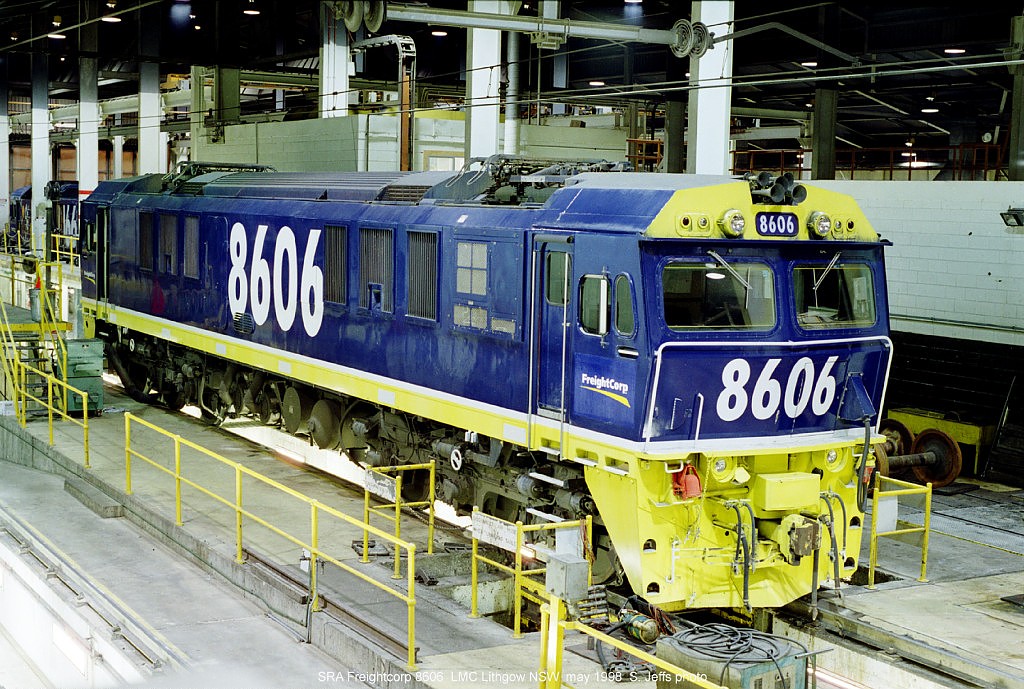
8606 sits above the drop-pit inside the Lithgow Locomotive Maintenance Centre workshop building on 1st May 1998. Photograph by Steve Jeffs.
|
|
|
Late in 2002 Pacific National commenced a disposal process for their surplus locomotives, including all members of the electric locomotive fleet. Following recommendations from Lithgow Locomotive Maintenance Centre, 8606 was selected as one of the top ranked operational units and was sold to the Sydney Electric Train Society effective 21st February 2003. The other 86 class loco initially set aside for preservation was 8646, obtained by the (then) N.S.W. Rail Transport Museum. The balance of the 85 and 86 class electric locomotives were then sold to Silverton Rail/Allco Finance.
After 9 months in storage and replacement of a defective battery, 8606 was operated light-engine (under electric power) from Lithgow LMC direct to Hornsby Maintenance Centre in Sydney on 31st March 2003. In doing this, 8606 gained the distinction of being the only withdrawn electric locomotive to leave Lithgow LMC under overhead power.
Following replacement of a defective frequency relay (used in starting the alternator) and a motor-alternator set overhaul (to rectify worn bearings and an uneven commutator surface), the locomotive ran its inaugural Society trip operating the 8606 Return to the North Tour on 6th December 2003.
In 2004 8606 was used together with 4615 to push-pull operate the AK train across the Sydney suburban system, including through the City Railway and ESR. For this the locos were used on the evening of 8/9th, and then the evenings from 12/13th to 15/16th July inclusive. 8606 has since been used on a number of the Society's trips, the last being our Terrain Tunnel Push-Pull Tour on the 29th October 2005.
In late 2004 four 86 class units were reactivated for hauling spoil removal trains from the Bondi Junction turnback excavation works. These were 8601, 8609, 8622 and 8644. Subseqently in November 2006 seven 86 Class locomotives were sold by Allco Management Limited - these being 8601 and 8650 (tri-bo unit) to Dorrigo Steam Railway and Museum. 8609, 8622 and 8649 to El Zorro and 8607 and 8644 to private buyers. The remainder of the 86 class fleet was scrapped at Broken Hill. Later former El Zorro units 8609 and 8622 were scrapped at Lithgow State Mine yard in 2017. As at 2018 all of the remaining 86 class locomotives are intended for preservation.
 |
|
8606 sits inside the Lithgow Locomotive Maintenance Centre workshop
building on 25th February 2003. Photograph by Hugh Burns.
|
|
|
Following a change of management at Railcorp's Hornsby Maintenance Centre and a change in policy away from embedding heritage electric stock in an operational depot, SETS moved 8606 (and its other items) to covered accommodation at the Junee RoundHouse Railway Museum on 7th June 2009. The loco was then opened to public display within the museum without its pantographs. (Which had to be removed for the transfer over non-electrified lines.)
On 16th and 17th June 2018, 8606 and the other SETS items were transferred from Junee RoundHouse back to Pacific National's LMC Lithgow for reactivation. In summary the works involved re-installation of two overhauled original-type SMC-EK pantographs, new pantograph hoses, a new set of batteries, new fire extinguishers, installation of ICE train radio equipment (which required the roof to be removed for modification and a new roof seal), testing of both and repair of one cab air-conditioning unit, provision of camping toilet, cleaning commutators and checking brushgear, meggering of all rotating electrical equipment, cleaning and test operation of all high-voltage switch gear, equipment changeout of all 26L brake equipment, changing around a dozen lamps and one inverter, relubrication and finally fit for service inspection and certification. These various works were undertaken by SETS, Pacific National Lithgow and their radio and mechanical maintenance contractor Progress Rail, and various specialist contractors (for pantographs, fire extinguishers and air conditioning).
On Thursday 25th October 2018, 8606 was taken on an electrically powered test run to Mount Victoria and back, with LMC Lithgow Shunter 48120 in tow. On Friday 26th 8606 hauled four 82 class locos up to Mount Victoria as a load test. On Saturday 27th 8606 was electrically transferred light engine from Lithgow to Clyde Yard in perfect weather.
One of the benefits of electric locomotive hauled trains is that they can be taken into Sydney's underground railways. Other than being a feature of SETS passenger excursions, this also makes electric locos useful for working the Robel rail train on underground lines. Pacific National has operated 8606 on the Robel train as E702 overnight from Monday 29th to Tuesday 30th October 2018, to drop rail between North Sydney and Central; as E704 overnight from Tuesday 27th to Wednesday 28th November 2018, to drop rail between Martin Place and Bondi Junction; and as E802 overnight from 7/8th to 10/11th January 2019 inclusive, to drop rail on the City Outer.
8606 was scheduled to haul the Robel Rail train again from the 25th February on the City Inner. However just past Circular Quay the loco suffered an interpole fault on its number 1 traction motor. The loco was first taken to Delec for examination and then to LMC Port Kembla for removal of this traction motor. The motor then received a full overhaul, including all necessary repairs. Following its reinstallation, 8606 was successfully tested on the 12th April.
8606 was rescheduled to complete the same City Inner rail drops from 15th April, however a train control error saw the locomotive with its Robel train routed over an un-wired crossover as it exited Enfield yard en-route to the City. Unfortunately the dewirement on the crossover and the subsequent recovery works largely destroyed both of 8606's overhauled pantographs.
Due to the urgency of the rail deliveries, one of the two remaining pantographs at Lithgow was specially overhauled by LRW in three days and refitted at Delec to return the loco to operation on the 29th April 2019. The loco subsequently operated the Robel train overnight on the City Inner from 29/30th April to 2/3rd May 2019 inclusive, then 13/14th to 16/17th May inclusive, and then 20/21st to 22/23rd May inclusive.
On the June long weekend, 8606 was on display at the 2019 Transport Heritage Expo, held on the Country platforms at Central Station. The loco was fitted with specially made headboards and parked at the terminal end of platform 4, with auxiliaries powered and its cab open for supervised public inspection. The loco proved very popular with the public.
A forth pantograph was completely overhauled and rebuilt with many new components by LRW and fitted to 8606 at Delec on 24th September 2019. The loco then operated the Robel train overnight from 30 Sept/1st October to 3/4th October inclusive. Further electric-hauled Robel operations are currently scheduled for December 2019.
|
|
About 8644
|
|
|
 |
|
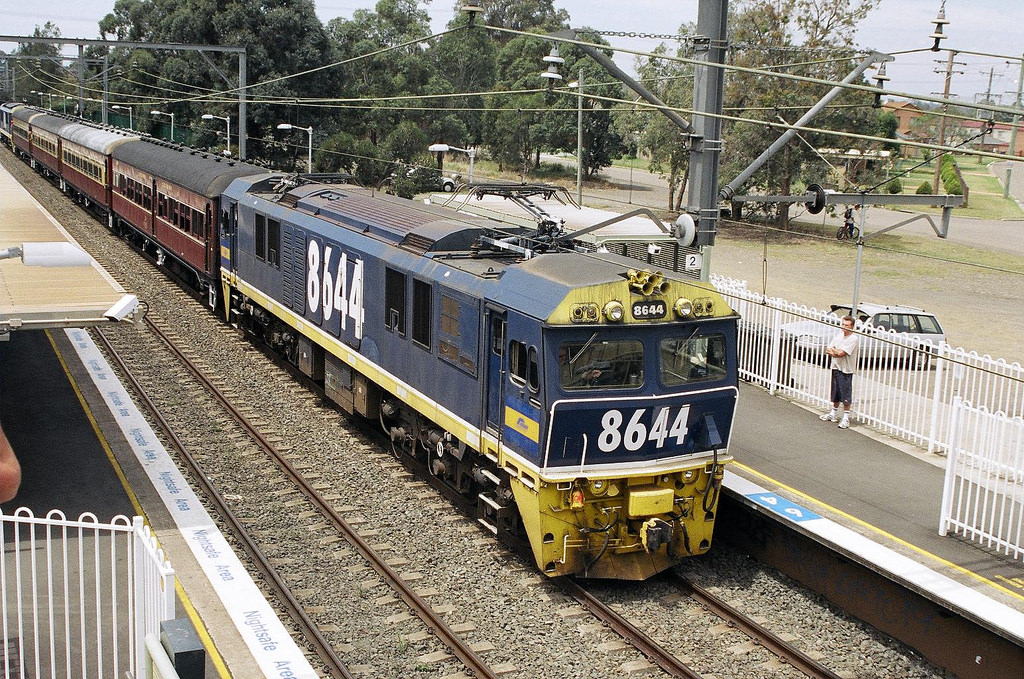
On Saturday 29th October 2005 SETS ran its Terrain Tunnel Push Pull tour which visited Campbelltown, Lithgow, Bankstown and the City Circle, and featured chartered electric locomotive 8644 operating with our own 8606.
Photograph by Michael McGinty.
|
|
|
Similarly to 8606, locomotive 8644 was delivered on 28th June 1985. It was withdrawn on 30th June 2002, following Pacific National's decision to cease operating all electric locomotives. Thus 8644 had a fairly short operational life of 17 years service.
8644 was among the fleet of locomotives moved from LMC Lithgow to Broken Hill for storage. However 8644 was one of the lucky six (8601/07/09/22/44/50) that were returned from Broken Hill, when it was selected to be one of the four 86 class units to be reactivated for hauling spoil removal trains from the Bondi Junction turnback excavation works in late 2004.
While the Bondi works were underway, the four 86 class locos were stabled at Eveleigh. As the Bondi works wound down in 2005, the locos became available for charter. Consequently SETS used 8644 on two trips with 8606 in August and October 2005 for double-heading and push-pull excursions. 3801 Limited also used 8644 on 19th February 2006 to operate their "Sea and Speed" tour to Kiama and Newcastle via the Harbour Bridge.
Following the successful double 86 class excursions, SETS applied to purchase 8644 to have a second 86 class loco permanently available. In November 2006 we were advised by Allco Management Limited that our submission was successful. The locomotive was purchased for preservation by three SETS members (holding equal shares) on 29th November 2006, who still own the loco. The locomotive was moved to Chullora for long term storage in 2009. However outside storage at Chullora for 9 years has proved very detrimental to the locomotive's steel body and brake equipment and the locomotive now needs significant body work, a repaint and some replacement brake gear to return it to traffic.
Currently 8644 is currently in storage but may become a backup unit to 8606 and 8649 in the future.
|
|
About 8649
|
|
|
 |
|
An official photograph of 8649 in brand new condition at LMC Lithgow around October 1985. Following on from the initial XPT livery, it was decided to introduce this stunning new paint scheme on all State Rail locomotives and country carriages.
SRA Photograph.
|
|
|
Again similarly to 8606, locomotive 8649 was delivered on 27th September 1985, and entered service on 4th October 1985.
One notable event in 8649's early service was its involvement in the official handover ceremony for restored steam locomotive 3801, on 15th November 1986. 3801 was overhauled by HVTC apprentices at the State Dockyard at Newcastle. To signify the project completion, the steam loco hauled a special train to Maitland and Newcastle Station for the "Return to Service" ceremony which was attended by large numbers of people, including invited dignitaries and the SRA's Railway Band. At the conclusion of the event, 3801 went to Cardiff Workshops and electric loco 8649 then took the official train and the invited guests from Newcastle back to Sydney, via the North Shore Line and the Harbour Bridge.
Following the reported discovery of cracks in its underframe, 8649 was simply withdrawn from service on 4th February 1998, off coal train BB 68. 8649 (and 8616) were moved from LMC Lithgow on 14/07/2000 and were taken to Werris Creek a couple of days later on 16/07/2000. Thus 8649 had a short operational life of just over 12 years service.
After the withdrawal of all remaining electric locomotives by Pacific National on 30th June 2002, 8649 passed through a number of owners including Silverton Rail/Allco Finance, El Zorro and Transition Rail Services. However despite the various changes in ownership, the locomotive was not moved from its storage location at Werris Creek.
Following the winding-up of El Zorro commencing on 23rd May 2013, all their remaining 86 class electric locos were disposed of. Ultimately 8609, 8622 and 8649 were sold to Mr Costa Lucas for scrapping. As a result, previously retained 8609 and 8622 were broken-up at State Mine Lithgow in 2017. However for 8649 action on this was delayed long enough for it to become apparent to SETS that Sydney Trains (and Pacific National) would need more than one 86-class electric locomotive for their planned City railway tunnel track-work and Harbour Bridge works. It was also clear they would need this in a fairly short timeframe.
The dry conditions at Werris Creek have resulted in fairly limited corrosion of the loco body, even after being stored outside for 20 years. After a quick assessment that 8649 appeared to be in generally good condition, SETS commenced negotiations and an agreement was reached for 8649 to be belatedly purchased for preservation on 8th July 2018. Following an engineering assessment, it was planned for 8649 to be the next 86-class locomotive to be recommissioned by SETS and Pacific National for Sydney Trains works.
 |
|
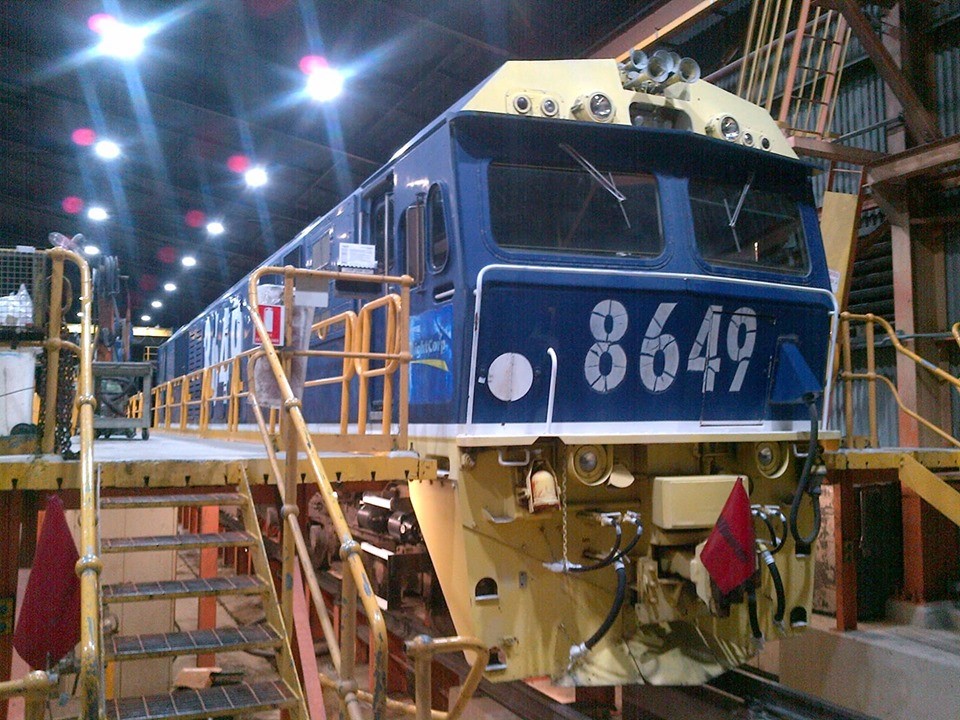
8649 sits inside the Werris Creek Locomotive Maintenance Centre workshop building on 15th October 2019. Brake equipment re-installation is in progress and the loco has just been washed to improve its appearence. Photograph by Hugh Burns.
|
|
|
Preparatory re-commissioning works on the loco commenced in September 2019 at Pacific National's Werris Creek workshops, run by Progress Rail. The first stage of the works was to prepare the loco for a rail transfer to Cardiff Workshops. Given the locomotive had not been operated in over 20 years and to ensure the locomotive could be moved safely, all 26L brake equipment was removed for overhaul and refitted. This included brake cylinders, spring parking brakes, drivers' cab equipment, brake rack gear, safety valves, and the hoses on each end of the loco. Additionally the locomotive's main air reservoir tanks were internally inspected. The exterior of the locomotive was also cleaned to improve its appearance and to assess the general state of the body and its paint finish.
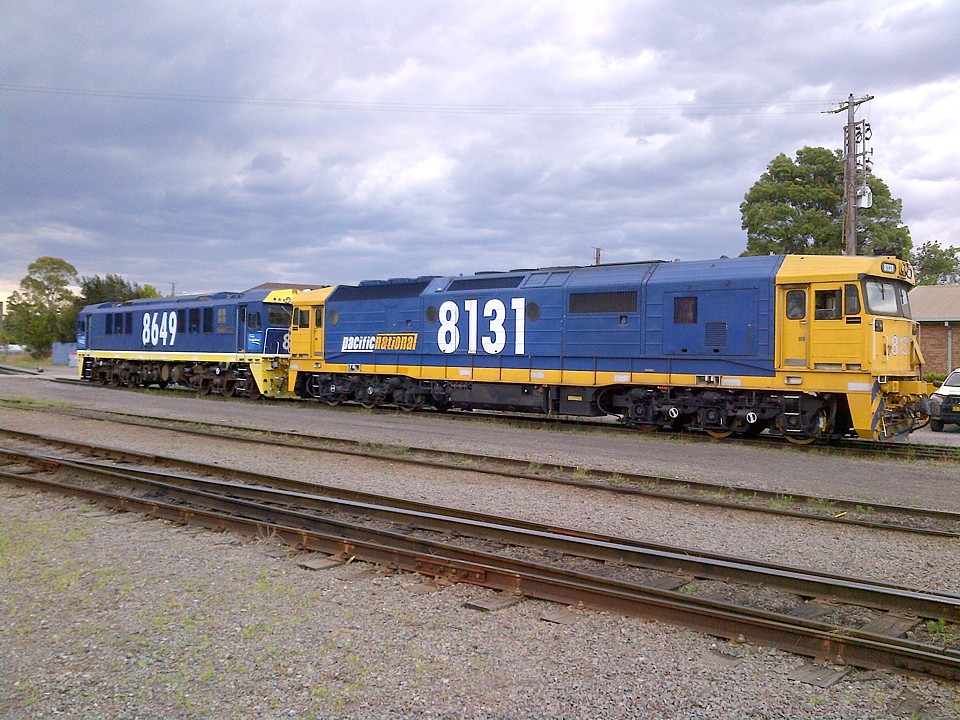
On the 2nd December 2019 8649 was transferred from Werris Creek to Morandoo Yard (near Broadmeadow) in preparation to be lifted off its bogies at Cardiff workshops, to enable a full examination of the underframe. This was completed satisfactorily and the loco was returned to Werris Creek for other works to continue.
 |
|
8649 after arrival at Morandoo Yard on the 2nd December, hauled by Pacific National's 8131. This was the first time 8649 had left the Werris Creek area in nearly 20 years. Photograph by Hugh Burns.
|
|
|
Beyond the brake gear changeout and underframe examination, recommissioning works included replacing the batteries, replacing the cab flooring with new "Pirelli stud style" flooring in a similar colour to that used when the locos were built, replacing all crew seats to meet modern ergomomic standards, remaking and fitting original style and colour numberboards, changing out the motor-alternator set for a freshly overhauled unit, exchanging a compressor due to a water damaged motor, replacing the compressor air ducting, replacing the compressor air and oil filters, changing the compressor oil, providing new fire extinguishers, provision of camping toilet, fitting an ICE radio system with all the requred antennae on the loco roof, testing all the lamps and switchgear, changing all internal marker and numberboards lamps to LED type and fitting a replacement overhauled SMC-EK pantograph.
 |
|
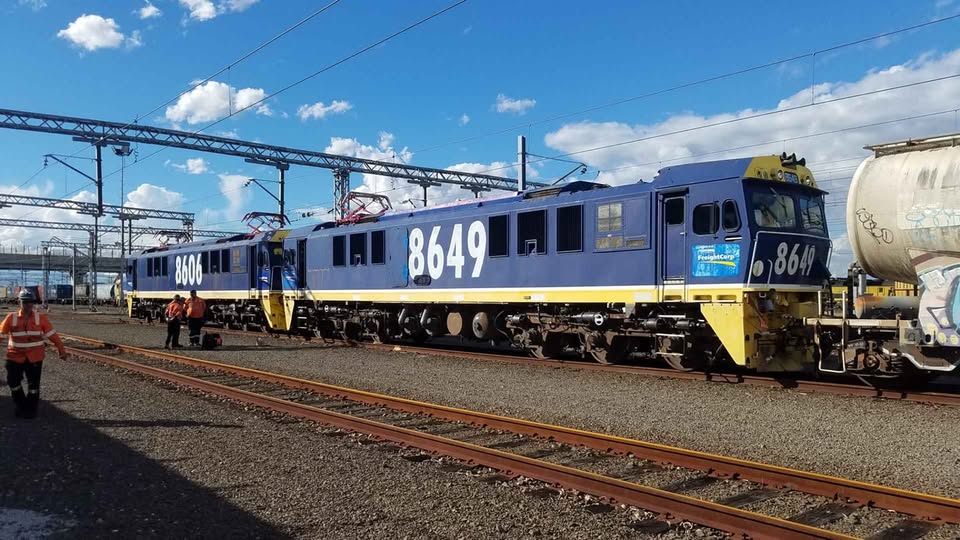
8649 and 8606 are coupled together in Enfield Yard on the 25th March 2021 for the first powering up of 8649 from the overhead in nearly 23 years. The first step was just to test run the compressors, motor-alternator and ventilation fans. Photograph by Hugh Burns.
|
|
|
After effectively 23 years in storage, 8649 was first repowered up in Enfield Yard, with the auxiliaries started from the overhead power on 25th March 2021 - i.e. the compressors, the overhauled alternator, and thus the traction motor ventilation fans. After initial testing on overhead power, further works included full overhaul and conversion of the two cab air conditioning units to R134a refrigerant, replacing a defective high pressure valve in one compressor and overhaul of no.2 traction motor blower fan, due to failed sealed bearings.
8606 and 8649 are fitted with Pacific National's standard ICE radio installation (as fitted to their diesel locos) which runs off 74 volts DC battery power. To enable use of this standard equipment, SETS commissioned specially made 120 to 74 volt DC voltage converters, so the standard 74 volt DC ICE radio equipment can be used on our 120 volt DC battery power electric locos.
To establish the reliability of the auxiliaries and further assist in drying the traction motors, 8649 was sent with 8606 on a Robel operation to the City Circle on the 15th Sepember 2021, where 8649's auxiliaries and fans were powered but the loco was not used for traction.
Once this step was passed and the locomotive had been thoroughly ventilated to dry out the traction motors, the locomotive was successfully test moved by powering its traction motors on Friday 24th September 2021. In the early hours of Tuesday 26th October 2021, 8649 was successfully operated light engine on the network, being run from Enfield to Central under electric power. It later returned to Enfield Yard hauling the Robel train and 8606.
 |
|
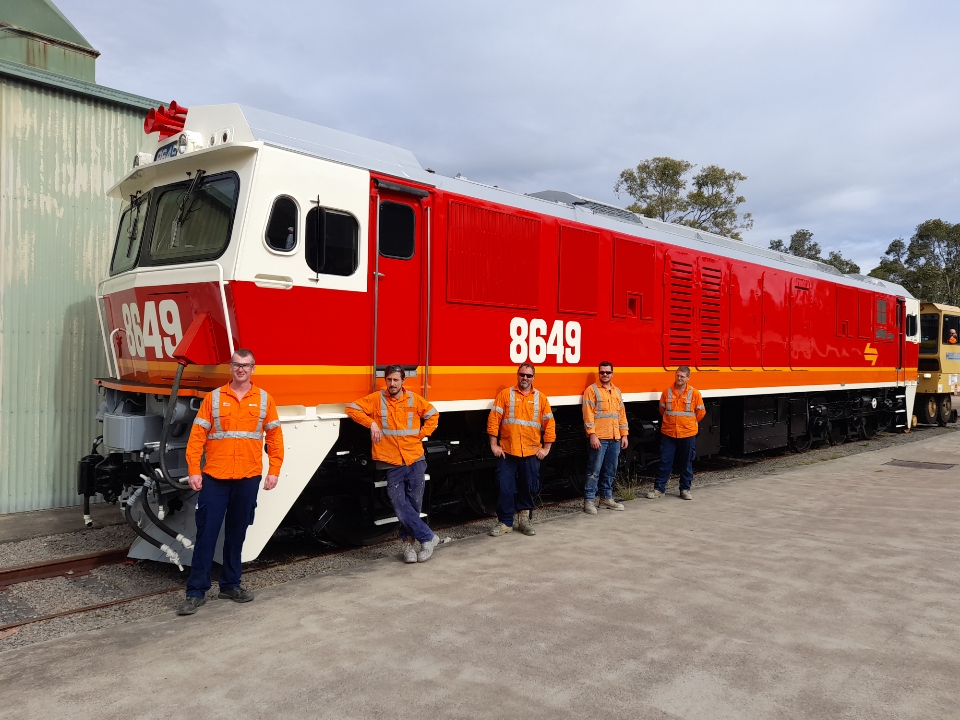
Freshly repainted 8649 at UGL Broadmeadow on 9th May 2022, together with the team that recreated the visual masterpiece. Photograph by Hugh Burns.
|
|
|
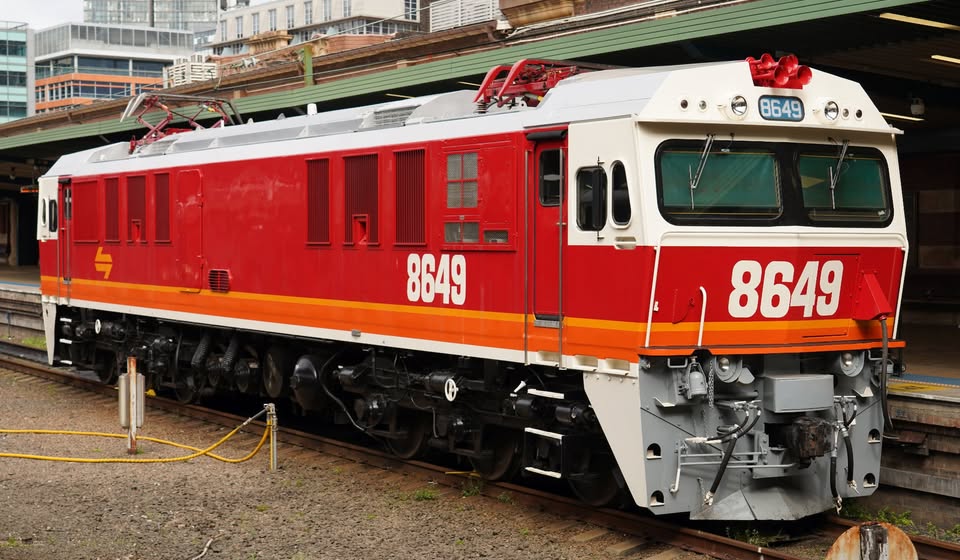
On the 25th November 2021 SETS was advised it had been successful with its Transport Heritage Grant application towards the cost of giving 8649 a full repaint back into Candy livery. The grant ended up as effectively a dollar for dollar contribution towards the full cost of having 8649 prepared and repainted, using Dulux two-pack polyurethane paint, by UGL Broadmeadow. As part of the repainting works, minor mechanical damage to the locomotive was repaired and to recreate the original appearence of the locomotive, two airtight dummy grills were made, to replace the blanking plates that had been installed in front of the traction motor blowers at each end.
Extensive research was undertaken to get the Candy livery colours as accurate as possible. The Australian Colour Standard AS K185, referenced on Candy livery drawings in 1982, had been superceded and two colours used had no close matches in the newer AS2700 Colour Standard. Additionally swatch samples of these original colours, needed for matching, were unavailable in Australia and New Zealand. So as the old Australian Colour Standard was based on a British Colour Standard BS381C, we ordered a colour swatch book from Britain to have the missing samples, to work with Dulux to get the best colour matches. The repainting works were completed on 9th may 2022 and 8649 is currently in 86 Class Mark 3 Candy livery.
8649 was requested to assist the operation of steam locomotive 3801 over the Sydney Harbour Bridge, through the city underground, in a major heritage event held on Sunday 25th September 2022. Once held by 3801 Limited, this steam loco is now managed by Transport Heritage NSW. 8649 banked the train attached to the rear and powered the train through the city underground, up onto the Harbour Bridge to North Sydney. With 3801 on one end and 8649 on the other, 8649 hauled the train from Enfield to Rhodes, from Waverton down to North Sydney Car Sidings, and from Hornsby back to Central. Coincidently this was the second time 8649 and 3801 have appeared at the same event, with the previous occasion being on the 15th November 1986 as outlined above.
 |
|
Freshly repainted 8649 powered up and on display at the end of platform 1 at Central during the 2022 Transport Heritage Expo in October 2022. Photograph by Hugh Burns.
|
|
|
8649 was invited to appear at the Transport Heritage Expo held at Central between 1st and 3rd October 2022. The loco was presented with its auxiliaries powered and the loco open for supervised cab visits. The large bright eye-catching locomotive was parked in the premium position at the terminal end of platform one. 8649 proved very popular with both enthusiasts and the public alike, being well attended by a constant stream of visitors throughout the long weekend.
Acknowledgment
The recommisioning of 8649 is the biggest project SETS has participated in to-date. Achieving this fantastic result has involved the input of many organisations and individuals. We would particularly like to thank Pacific National, Progress Rail Werris Creek, Progress Rail Clyde, Progress Rail Cardiff, SETS and members, Eclectic Engineering, Thermoking, Moxan Industries, UGL Broadmeadow, Dulux Broadmeadow, PRE Engineering and all our specialist suppliers. Particularly thanks are due to Tim Elderton, Ken Lieschke, Andrew Paine and Cameron Parker.
Locomotive notes by Stephen Halgren and Hugh Burns.
December 2022
|
|
Further Information
|
Related reading:
NSW 86 Class Electric Locomotive Technical Documentation
See Also:
Electric Locomotive 4615
Electric Locomotive 8501
Single Deck Suburban (EMU) Passenger Cars
Single Deck Interurban (EMU) Passenger Cars
|
|
|


